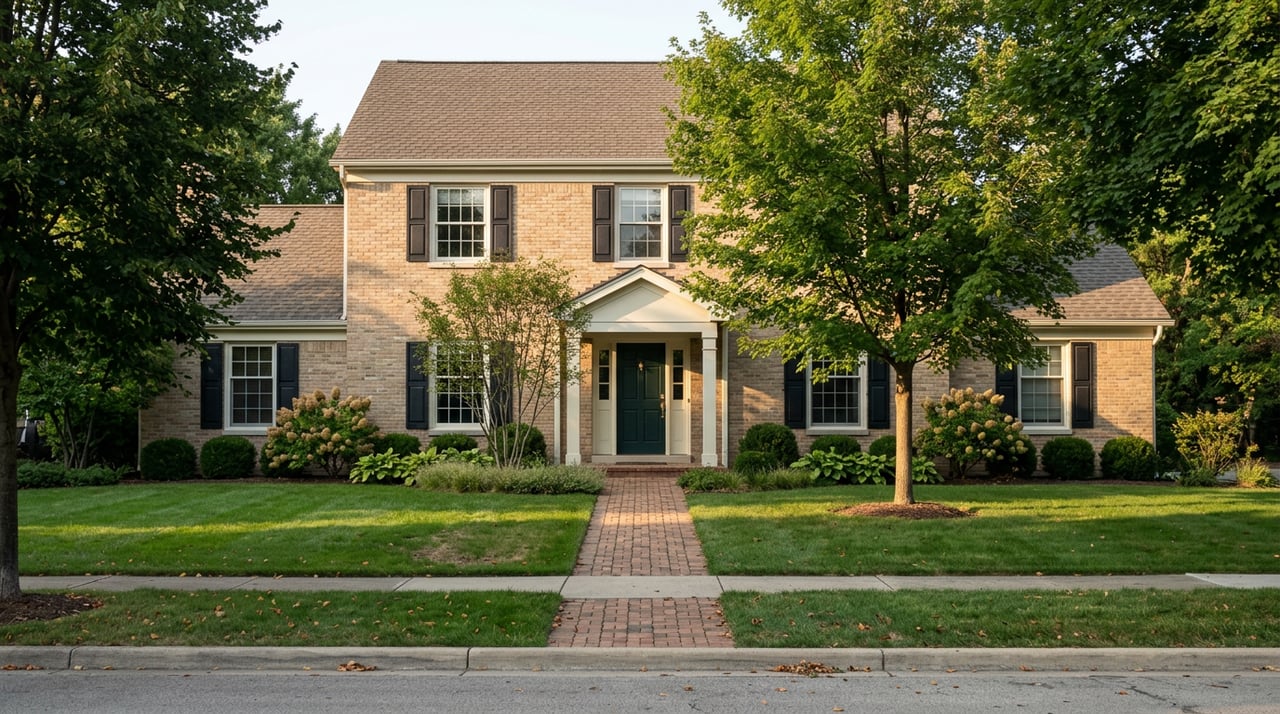
La Grange Park vs La Grange Home Prices, Explained
While La Grange displays a higher median home sale price of $775,000 compared to La Grange Park's $545,000, La Grange Park is actually more expensive on a per-square-foot basis ($313/sq ft vs $299/sq ft). The $230,000 headline gap reflects home size differences rather than cheaper land value. Both suburbs have areas served by Lyons Township High School District 204.
Analyze active listings, square footage rates, and Metra commuter access across La Grange and La Grange Park.
Market Metric | La Grange Park, IL (60526) | La Grange, IL (60525) |
|---|---|---|
Median Sale Price | $545,000 (Jan 2026) | $775,000 (Mar 2026 / 12-Mo Trailing) |
Price Per Square Foot | $313 / sq ft (+11.2% YoY) | $299 / sq ft (-24.3% YoY) |
Average Days on Market | 40 days | 48 days |
Monthly Closed Sales | 3 sales (Jan 2026 sample) | 13 sales (Mar 2026 sample) |
High School District | Lyons Township High School District 204 (much of La Grange Park) | Lyons Township High School District 204 (most of La Grange) |
Metra Commuter Transit | Drive/walk to neighboring stations | 2 Stations (La Grange Road & Stone Ave) |
Our Pick For | Buyers wanting lower headline costs for smaller layouts | Buyers prioritizing larger square footage & walk-to-train |
Ask a buyer comparing La Grange to La Grange Park which town costs more, and they will name La Grange without pausing. It has the walkable downtown, two Metra stations, and a century of streetcar-suburb pedigree that sounds expensive. Look past the sticker price to what a square foot actually costs in each town, and the story gets more complicated than the medians suggest.
In January 2026, homes in La Grange Park sold for a median of $545,000, according to Redfin. In March 2026, homes in La Grange sold for a median of $775,000. That's a $230,000 gap, and it's the number most people stop at. It's also only one part of the comparison.
Redfin's La Grange Park figure came from just three homes sold in January 2026, down from eleven a year earlier, with days on market falling to 40 from 74. La Grange's March figure came from 13 homes sold, up from 11 the prior March. A median built on three transactions moves however those three homes happen to be priced. A median built on thirteen has a little more room to breathe, but it's still a single month.
Widen the window and the number for La Grange holds. Twelve months of closed MLS data through June 2026 puts the detached median at the same $775,000, up 9.2% year over year, with an average sale price of $841,902 and a list-to-sale ratio of 103.1%. That figure comes from 125 closed detached sales, not three or thirteen. When a single month and a full year land on the identical number, that's a market with enough volume to trust its own median. La Grange Park has a smaller sample, making the sample-size gap more important than the price gap itself.
The price-per-square-foot figures offer another way to compare these two towns. La Grange Park's median sale price per square foot was $313, up 11.2% year over year. La Grange's median sale price per square foot, one month later, was $299, down 24.3% year over year.
Read those two lines again. The town with the lower headline price is, on a per-square-foot basis, the more expensive one to build or buy into. That adds another perspective to the comparison.
What that means in practice: the $230,000 gap in median price is not a location premium. It's mostly a size premium. La Grange's housing stock nearer downtown runs larger, on average, with more square footage per sale. La Grange Park's stock leans toward smaller ranch, bi-level, and split-level construction mixed with colonials, so the median home sold there is simply a smaller house. You're not paying less per square foot to live in La Grange Park. You're buying fewer square feet.
If the price gap isn't about land value, is it about schools? Not as much as buyers assume. Most of La Grange feeds into Lyons Township High School District 204, one of the shared high school districts along this stretch of the BNSF corridor, and much of La Grange Park feeds into the same high school. Where the two towns actually diverge is at the elementary level: La Grange Park is largely served by La Grange School District 102, with Ogden Avenue School and Park Junior High as local feeder schools, while La Grange itself splits between Districts 102 and 107 depending on the block. Verifying the exact elementary assignment on a specific address matters more here than assuming the pricier town buys a different high school. It usually doesn't.
The other piece of the premium is real, and it's specific: La Grange has two Metra stations on the BNSF line, La Grange Road and Stone Avenue, four-tenths of a mile apart. Both put commuters into Chicago's Union Station in roughly 20 to 30 minutes depending on the train.
La Grange Park has neither; residents use nearby stations in La Grange. Typical commute times from La Grange Park run 25 to 35 minutes by train and 30 to 45 minutes by car, depending on which of La Grange's stations you drive or walk to. That's a workable commute. A block in La Grange within a five-minute walk of either platform and a block in La Grange Park a mile from both are not experiencing the same commute, even though both towns share the same railroad.
That distinction matters more inside La Grange Park than it does inside La Grange, because the walk-to-train experience varies block by block rather than town by town:
Put the pieces together and a clearer picture forms. The $230,000 gap in median price is not evidence that La Grange is the more valuable town per square foot. It's evidence that La Grange's median sale is a bigger house. The land under both towns carries a similar per-square-foot cost. The schools largely overlap at the high school level. The real premium buyers are paying for in La Grange proper is the five-minute walk to a platform and a downtown, not a fundamentally different market.
For a buyer choosing between the two, that reframes the decision. If what you actually want is more square footage for your budget and you're comfortable with a short drive to the train, La Grange Park's East side or Robinhood Estates gets you there. If the walk to the platform and the downtown routine is the point, no amount of square footage in La Grange Park substitutes for it, and that premium is worth paying deliberately rather than assuming it's baked into a lower price somewhere else.
Anne Hodge is a top-producing real estate broker specializing in La Grange, La Grange Park, and Chicago's western suburbs. With deep expertise in local school boundary maps, transit proximity, and price-per-square-foot market valuations, Anne provides data-driven guidance for suburban home buyers and sellers. Over the past 12 months, Anne has closed over $25 million in residential real estate sales across Cook County.
Because the median price difference is mostly a size difference, not a value difference. Buyers paying more in La Grange are largely paying for a bigger house and closer proximity to a train platform and downtown, not for underlying land that's worth more per square foot.
It varies widely and can run into the single digits, as it did in January 2026 with three closed sales. That's low enough that one unusual sale can swing the median 10 or 15 percent in either direction. Ask for trailing 12-month figures, not a single month, before drawing conclusions.
It shifts where the premium lands rather than erasing it. Homes closer to La Grange's platforms, particularly in East La Grange Park, tend to carry more of a walkability premium than homes farther into Harding Woods or Robinhood Estates, even though all three sit within the same village.
La Grange Park is primarily served by La Grange School District 102 (Ogden Avenue School and Park Junior High). La Grange is split between District 102 and District 107 depending on the street block. Areas of both villages are served by Lyons Township High School District 204.
Evaluating western suburban properties? Read our comprehensive La Grange Real Estate Guide, view active La Grange Park Homes for Sale, or examine our La Grange vs Western Springs Comparison Guide.
Stay up to date on the latest real estate trends.
Anne thoroughly enjoys her profession and has a deep sense of responsibility to her clients. She understands the magnitude of selling or buying a home, and works tirelessly to make sure her client's goals are met.